
Home
Spinstorian: Merging the words spinster and historian, this website gives a voice to women from the past whose lives are not found in history books.
Spinster: a term previously used to describe an older unmarried woman or one who was unlikely to marry. History books unkindly referred to unmarried women as old maids, regarding them as too old or not attractive enough to gain a husband.
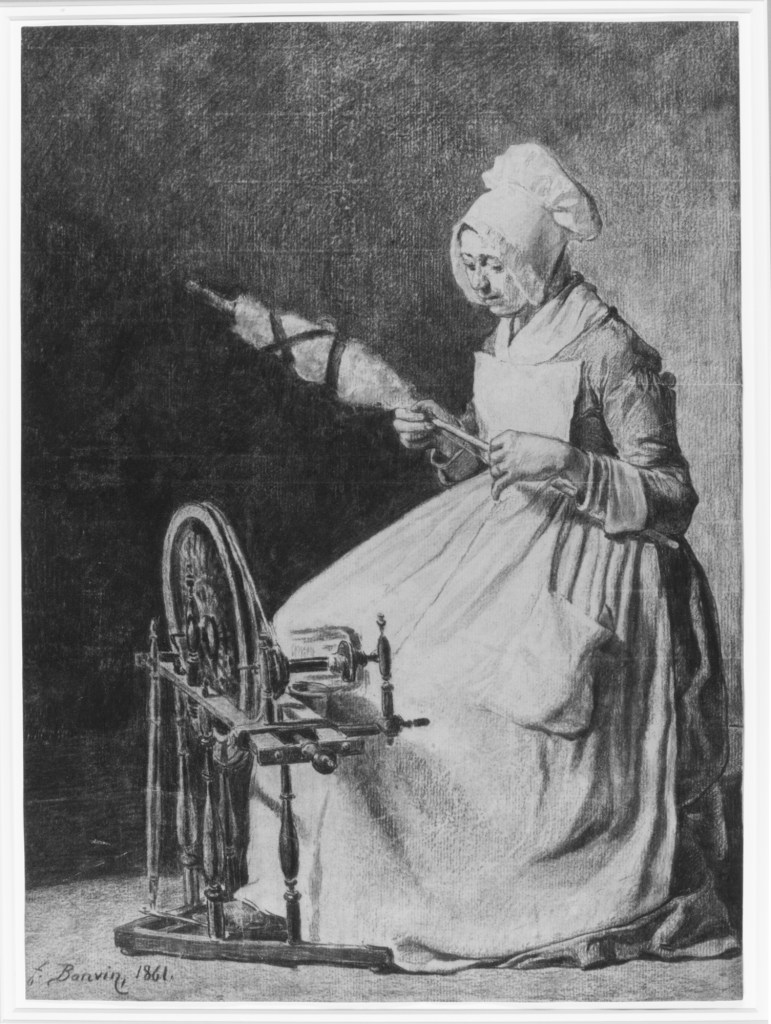
A spinster originally referred to a girl or woman who made their living working from home spinning thread or yarn. As many were unmarried, the name ‘spinster’ was added to the end of her name to describe her occupation, eventually becoming the term for unmarried women (Oxford Dictionary of Word Origins, 2021). These spinsters were independent women who earned their own living. The drawing on the left from 1861 shows a woman holding a distaff wound with flax she is about to spin into yarn on a spinning wheel. [1]
With the industrialisation of manufacturing processes in the late eighteenth and early nineteenth century, cottage industries involving all the family, such as spinning, became redundant as large mills took on the work with automised machines.
This meant that many working class women could no longer work at home and look after children. This created a divide between home and work and established the Victorian family ideal of the subservient caregiver wife. Home was the domestic sphere of women to bring up children and the public sphere was work and business which men inhabited.
For working class women with children, this created a childcare problem as they were required to either go out to work and leave their children with family, friends or neighbours or stay at home and look after the children. Unmarried women often took up positions as domestic servants, sometimes residing with their employers. The construct of the idealised Victorian family therefore did not recognise the reality of working class lives, where the majority of women had no choice but to work regardless of whether they were married, unmarried or had children.
With marriage and family as the ideal and spinsters outside of this, the term spinster took on a derogatory and misogynistic meaning. In fact the term spinster was still used to describe an unmarried woman on UK marriage certificates until 2005, when it was replaced with ‘single’ for both women and men. Note that the term bachelor for an unmarried man is not associated with any derogatory connotations.
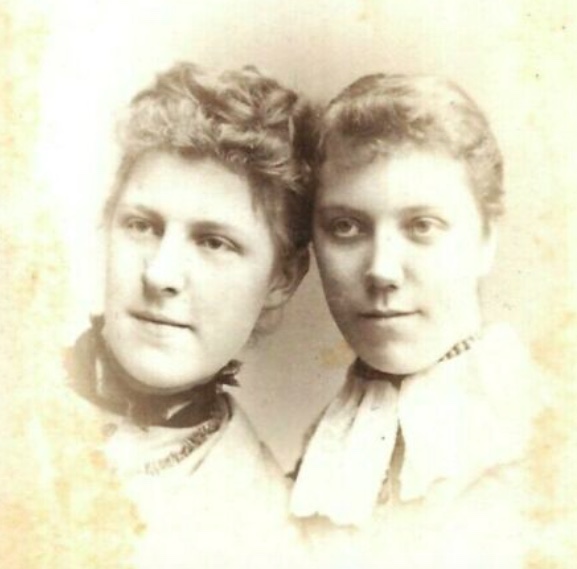
But single women embraced their freedom from marriage, carving their own paths and lives. Upper class women found their niche undertaking charitable activities and often formed close friendships like these women in the photo on the right in Braemar, Scotland from 1886. [2] Read more about this in the section on Female Philanthropists and Lady Bountifuls.
Campaigners such as Florence White (1886-1961), reclaimed the term, creating the National Spinster Pension Society in the 1930s. She led rallies and lobbied the government for the provision of housing for single women and the reduction of the retirement age for unmarried women.
Spinsters were independent, clever, tenacious and headstrong women.
At Spinstorian, a voice is given to women whose stories have never been written into history due to their gender, social status, class, poverty, sexuality or other marginalised characteristic.
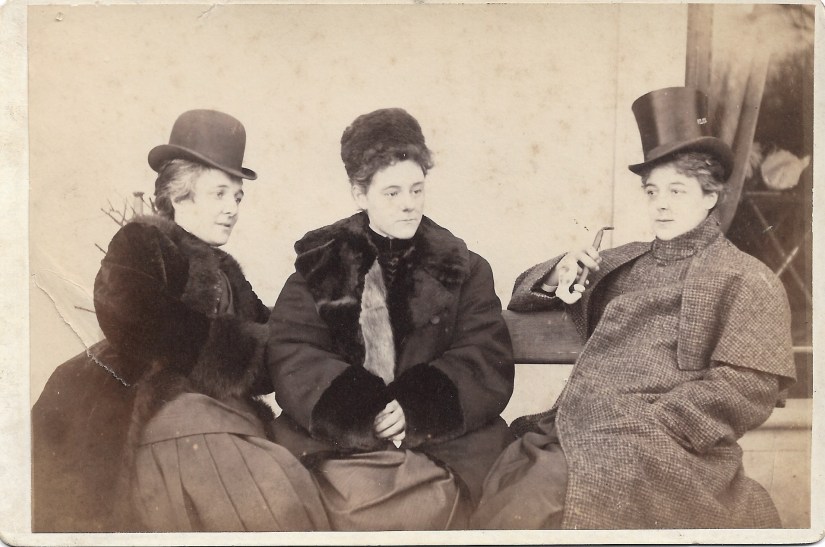
The cabinet card on the left shows three likely spinsters from the 1890s inverting the social norms expected of Victorian women with their hats, clothes and pipe smoking. [3]
The lives of these women will be explored on the Herstories blog page.
Image Credits
[1] Woman spinning flax, drawing by Francois Bonvin, 1861 (Wikimedia Commons)
[2] Two Victorian Women, Braemar/Aberdeen, Scotland, 1886, Cartes-de-visite (Author’s Own Collection)
[3] Three possible spinsters, one wearing a top hat and smoking a pipe, 1890s, Cabinet card (Author’s Own Collection)
Copyright (c) Ruth Washbrook 2023 / third party copyright holders
 Spinstorian